Archive for the ‘Space Flight’ Category
ISS (International Space Station) UK Passes April 2013.
ISS UK Pass details for April 2013.

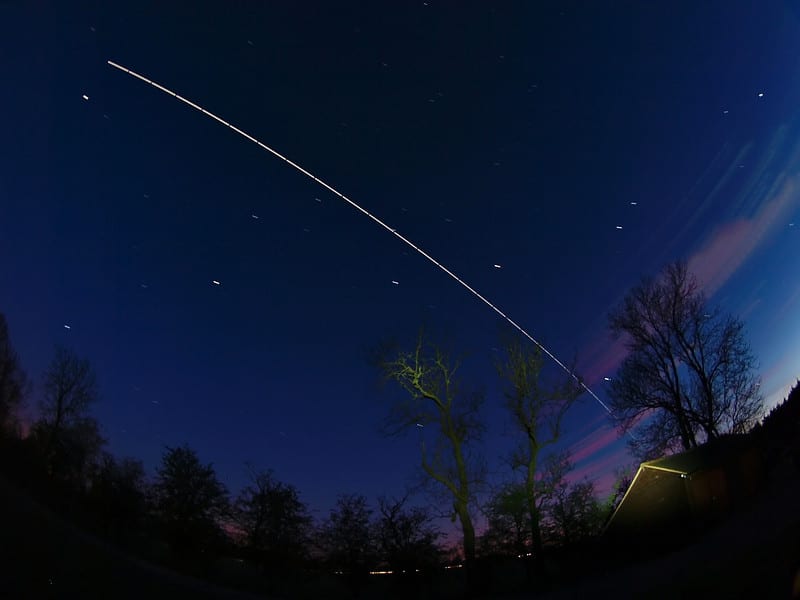
Long Exposure photo of a visible ISS pass Credit: Mark Humpage
The International Space Station (ISS) is back over UK skies with bright passes during April 2013.
The ISS is a large Space Station/ laboratory orbiting the Earth, it can be spotted with the naked eye at certain times as it orbits the planet at 17500mph at an altitude of roughly 200 miles.
Spotting the station is very easy and you don’t need any special equipment, only your eyes. Read the rest of this entry »
ISS (International Space Station) UK Passes February 2013.
ISS UK Pass details for February 2013.

Long Exposure photo of a visible ISS pass Credit: Mark Humpage
The International Space Station (ISS) is back over UK skies with bright passes during February 2013.
The ISS is a large Space Station/ laboratory orbiting the Earth, it can be spotted with the naked eye at certain times as it orbits the planet at 17500mph at an altitude of roughly 200 miles.
Spotting the ISS is very easy and you don’t need any special equipment, only your eyes. Read the rest of this entry »
ISS (International Space Station) UK Pass details for the 2012 Christmas period.
ISS UK Pass details for the 2012 Christmas period.

Long Exposure photo of a visible ISS pass Credit: Mark Humpage
The International Space Station (ISS) is back over UK skies with bright passes over the Christmas 2012 period.
The ISS is a large Space Station/ laboratory orbiting the Earth, it can be spotted with the naked eye at certain times as it orbits the planet at 17500mph at an altitude of roughly 200 miles.
Spotting the ISS is very easy and you don’t need any special equipment, only your eyes. Read the rest of this entry »
Red Bull Stratos – freefall from the edge of space
Red Bull Stratos is a mission to the edge of space that will try to surpass human limits that have existed for more than 50 years. Supported by a team of experts, Felix Baumgartner will undertake a stratospheric balloon flight to more than 120,000 feet / 36,576 meters and make a record-breaking freefall jump in the attempt to become the first man to break the speed of sound in freefall (an estimated 690 miles / 1,110 kilometers per hour), while delivering valuable data for medical and scientific advancement.
Source: Youtube
UK ISS Passes Over The Meteorwatch Period

Long Exposure photo of a visible ISS pass Credit: Mark Humpage
Please see:
ISS (International Space Station) UK Pass details for Christmas 2012
It’s meteorwatch and as well as shooting stars from the Perseid meteor shower, we can see some excellent International Space Station (ISS) passes alongside the celestial fireworks. Read the rest of this entry »
Beginners Guide to Photographing the International Space Station (ISS)
Photographing the International Space Station (ISS)
If you have seen the International Space Station (ISS) pass over a few times with your own eyes, (here’s a guide to seeing the ISS) you may want to have a go at photographing it.
Photographing the ISS is very worthwhile and gratifying. There are two basic methods; one being easy and the other being a little more difficult. Both methods are incredibly rewarding and good results can be obtained fairly quickly, once you have mastered the basics. Read the rest of this entry »
Beginners Guide to Seeing the International Space Station (ISS)
The ISS is a huge space station orbiting Earth that serves as an orbital laboratory, factory, testing ground and home; crew members conduct experiments from biology to astronomy, including experiments for prolonged exposure to life in space for future missions to the Moon and beyond.
The ISS is major accomplishment for NASA (US), ESA (Europe), JAXA (Japan) CSA (Canada) and all the countries involved (16 in all). The space station is just over 72 m long by 108 m wide and 20 m high; it is maintained at an orbital altitude of between 330 km (205 mi) and 410 km (255 mi) and travels at an average speed of 27,724 kilometres (17,227 mi) per hour, completing 15.7 orbits per day.
One of the best things about the ISS is that you can see it with your own eyes from Earth! It’s very easy to watch the International Space Station pass over your own backyard! Read the rest of this entry »
What Is The International Space Station (ISS)

The International Space Station
The international space station (ISS) is a habitable artificial satellite in low Earth orbit. It is the latest and largest in a line of previous space stations such as Skylab and Mir.
The ISS is a modular structure and the first module was launched in 1998 and many more modules, trusses, solar arrays and other elements have been added since.
The station is just over 72 m long by just over 108 m wide and 20 m high; it is maintained at an orbital altitude of between 330 km (205 mi) and 410 km (255 mi) it travels at an average speed of 27,724 kilometres (17,227 mi) per hour and completes 15.7 orbits per day. Read the rest of this entry »
AstroEvents- Hunting things that “Flash” in the January Sky

Credit: David Dickinsen
2012 is here, and the world shows no sign of ending as the heavens spin on their appointed rounds high overhead. But the diligent observer may be rewarded with several unique an spurious sights, both natural and manmade…
1st up is everyone’s favorite meteor shower named after an obsolete constellation; the Quadrantids peak the morning of January 4th in what is the first large meteor shower of the year. The peak is very swift, only lasting about 12 hours or so and is centered this year on 2:00 AM EST/7:00 AM UTC. This favors the U.S. East Coast in 2012, as the 79% waxing gibbous Moon will set around 2AM local the morning of the 4th for observers in mid-northern latitudes. The radiant of the shower lies at a declination of 52° degrees north at the junction of the modern constellations of Draco, Bootes and Hercules, and thus activity may be visible pre-midnite local, although the setting of the Moon and the rising of the radiant will raise sighting prospects considerably. Expect swift-moving meteors headed outward from the radiant above the handle of the Big Dipper to appear anywhere in the sky. The Quadrantids have been known since the early 1800’s, but there has been much conjecture as to the source parent body. Astronomer Fred Whipple noted in 1963 that the stream bears some resemblance to the Delta Aquarids, and that the orbital path has undergone alterations by the planet Jupiter in the last few thousand years. In 2003, SETI researcher Peter Jenniskens proposed that the source may be then recently discovered asteroid 2003 EH1, which has been tentatively linked to Comet C/1490 Y1, which approached Earth at a distance of 0.52 Astronomical Units on January 12th 1491. Be sure to keep an eye out for Quadrantids on these chilly January mornings, as we commemorate Quadrans Muralis, a constellation that is no longer! Read the rest of this entry »