2011 has been quite a year, both terrestrial and otherwise. This week sees the last of the big scheduled astronomical happenings of the year in the form of the Geminid meteor shower.
This shower is one of the yearly standbys along with the Perseids that are always sure to produce. The Geminids have a long peak centered on the morning of December 14th when an idealized Zenithal Hourly Rate (ZHR) of up to 120 meteors per hour may be seen.
Problems will arise, however, from an 82% illuminated waning gibbous Moon in the adjacent constellation of Cancer. Rising roughly around 10PM local on the night of the peak, this makes for the worst possible Moon phase as it’ll be high and bright in the early AM hours, just as the meteor shower is getting into high gear. But as always, I wouldn’t let that stop you from looking! (more…)
Some time in the small hours of Friday or Saturday morning (21-22 October 2011) the Orionids meteor shower will reach its peak activity rate. The peak occurs some time around 21 October each year, but this year it’s uncertain which day it will fall on.
The Orionid's parent Comet P/Halley as taken March 8, 1986 by W. Liller, Easter Island, part of the International Halley Watch (IHW) Large Scale Phenomena Network.
Meteor showers result from the Earth passing through the trail of dust and debris left behind by a comet. In the case of the Orionids the parent object is the most famous of all the comets – Halley’s Comet.
The peak meteor rate for the Orionids is lower than some of the more spectacular showers (the Perseids in August, the Geminids in December, and the Quadrantids in January all regularly outperform the Orionids) but it is still worth looking out for.
The meteors will appear to radiate from the constellation of Orion (hence the name) but they will streak across the sky in all directions, and so you shouldn’t confine yourself to only looking towards this one constellation.
On Thursday and Friday evenings the radiant rises in the east around 2200 BST (2100 UT) and continues to rise to its highest in the south just before the sky starts to brighten at 0600 BST (0500 UT). The higher the radiant above the horizon the more meteors you will see. However a crescent Moon will rises in the east on both mornings, the light from which will drown out some of the fainter meteors.
This shouldn’t matter much to you if you’re observing from an urban or suburban area, as the man-made light pollution in the sky will do a far better job of obscuring the meteor shower than the Moon will, but for lucky observers in dark sites (and I’ll be one of them, as I’m spending the weekend on Sark, the world’s first Dark Sky Island) the Moon may interfere.
Here’s a table with estimated hourly rates based on dark skies / suburban / urban areas, at hourly intervals throughout the night, assuming a ZHR =40 throughout this period (It may be that the peak will fall outwith this period, e.g. in daylight hours, so these are best-case-scenario numbers).
Time (BST)
Radiant
Altitude
Radiant
Direction
Hourly Rate
Urban Site
Hourly Rate
Suburban Site
Hourly Rate
Dark Sky Site (if Moon not present)
2200
rises
ENE
<1
<1
<1
2300
8°
ENE
1
2
4
0000
16°
E
1
4
8
0100
24°
ESE
2
6
16
0200
33°
ESE
2
8
22
0300
40°
SE
2
9
26*
0400
46°
SSE
3
10
29*
0500
50°
S
3
11
31*
0600
50°
S
3
11
31*
* the true rates, given that the Moon is causing natural light pollution, are probably half these values.
All of these timings and altitudes are based on an observer in central Scotland. For other UK observers the values in columns 2-4 may be slightly off, but not noticeably so.
Observing Advice: wrap up warm, head out before midnight, sit youself in a reclining lawn chair, and enjoy the spectacle. The rates may pick up around 0200 BST on Thursday or Friday and may stay high until dawn.
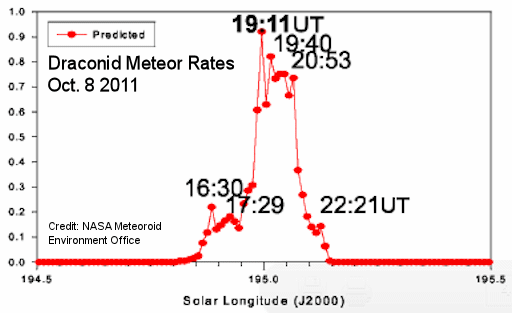
On October 8th, Earth will pass through a network of dusty filaments shed by Comet 21P/Giacobini-Zinner. Forecasters expect the encounter to produce anywhere from a few dozen to a thousand meteors per hour visible mainly over Europe, northern Africa and the Middle East. The meteors will stream from the northern constellation Draco–hence their name, the “Draconids.”
Peak rates should occur between 1600 UT and 2200 UT (noon – 6 pm EDT) as Earth grazes a series of filaments nearly intersecting our planet’s orbit. Analysts at the NASA Meteoroid Environment Office prepared this plot showing how the meteor rate is likely to vary:
If the maximum around 1900 UT reaches 1000 meteors per hour, the 2011 Draconids will be classified as a full-fledged meteor storm. The question is, will anyone see it? Bright moonlight over Europe, Africa and the Middle East will reduce the number of visible meteors 2- to 10-fold. The situation is even worse in North America where the shower occurs in broad daylight.
One way to enjoy the Draconids, no matter where you live, is to listen to them. The Air Force Space Surveillance Radar will be scanning the skies over the USA during the shower. When a Draconid passes through the radar beam–ping!–there will be an echo. Tune in to Space Weather Radio for live audio.
A similar system, still employing the radio reflection method displays meteors coming in on your computer in the form of a live graph – Meteor Live View
In Europe, an international team of scientists plans to observe the shower from airplanes flying at ~30,000 feet where the thin air reduces the impact of lunar glare. In Bishop, California, a team of high school students will launch an experimental helium balloon to higher altitudes, 100,000 feet or more, where the sky is black even at noon. Cameras in the balloon’s payload might catch some Draconid fireballs during the peak hours of the outburst.
Stay tuned for updates as Earth approaches the debris zone.
Meteors streaking across the sky are an amazing sight. Every time I see a meteor is a thrilling moment.
I’m not a professional astronomer or even a specialized expert. I’ve just been watching the skies for meteors and showing others how to spot them for a long time. I particularly enjoy helping people who have never seen a meteor before experience their first sighting. My greatest success is watching the Perseid Meteor shower together with my kids while we were camping in the mountains together. It is an emotional memory that we’ll share all our lives.
Watching meteors is special because it truly takes no special equipment whatsoever. Telescopes or cameras just restrict your field of view – for best viewing simply lie back and enjoy the sky in front of your own eyes.
Meteorwatch itself is special for a lot of reasons. It is a world-wide event of professional and amateur astronomers getting together to share the heaven’s most showy display of the year. It’s an opportunity to collect real data that may be useful for astronomers to work with to increase our understanding of space. For me, meteorwatch is a chance to share my excitement with others who have never seen the beauty of a meteor flashing overhead.
Our goal for meteorwatch is to increase the odds for everyone to find meteors. Meteorwatch occurs August 12 through August 14 to correspond with the Perseid Meteor shower. The Perseids are a predictable shower that comes every year. In fact, meteors from the Perseids have been observed for about 2000 years already! The meteors are frequent and fairly bright, so it’s likely that you’ll be able to spot one if you go out prepared.
The first step of being prepared is that you need to find the darkest place you can find, as far away as possible from lights that will disrupt your night vision. If the moon is out while you’re observing, try to block it as best as you can with trees or a hill so you don’t look at it and ruin your night vision. If your night vision does get disrupted, you will not be able to see the dimmer meteors at all, so keep your eyes up and don’t pull out your phone to tweet every few minutes.
It’s true that Perseid meteors will likely come at between one and two meteors every minute, but you won’t be able to see that many because most of them are dim and washed out by city lights. The darker it is, the more meteors you will see! When I’m in a reasonably dark area near the outskirts of my city I’m happy to see one meteor every five minutes or so. If you can’t get out of the city, you may have to wait longer because you will only see the brightest meteors. There are plenty of sightings from the heart of cities, so it’s not impossible, just more difficult. It’s certainly worth an attempt if you can find a park without lights or some other dark area near you.
The second step is to make sure that you’re comfortable while waiting. A good chair that supports your neck while you look up is helpful. Even though the Perseids occur during summer, the nights can get quite chilly so dress warmly and bring something warm to drink.
The third step is to keep it an enjoyable outing. Some people like to go out alone and listen to music while waiting. That’s great too, but I usually tell first-timers to go out in groups. I especially encourage people to take their kids out. Young eyes may see phantom meteors at first, but once they get the hang of it they’ll spot meteors too dim for you or I to spot any more. Kids are fantastic at spotting meteors and it encourages them to be interested in the world around them. Besides, who wouldn’t appreciate a late night out once in a while?
The most frequent question I get asked year after year has been, “Where should I look in the sky to see the meteors?” In the past I’ve tried to describe how to find the constellation Perseus, but it’s rather unnecessary. Accustom your eyes to the dark, and after you’ve seen three or four meteors you should be able to figure out where Perseus is in the sky all on your own! It’s most important to look up, be relaxed and patient, and the meteors will dazzle in front of you as long as you are willing to watch.
Unfortunately, we don’t all get clear skies. Some of us are clouded out and have no chance at spotting meteors above us, but that doesn’t mean you’re out of luck. Follow the #meteorwatch hashtag on twitter for tips, pictures, radio observing and to share your experiences with other enthusiasts around the world. Go to www.meteorwatch.org for news and information and be sure to follow twitter.com/VirtualAstro for fantastic coverage of the Perseid Meteor shower direct from his Astrobunker.
Mark Zaugg is an amateur astronomer and enthusiast who particularly enjoys introducing people to the excitement of seeing a meteor in person. You can find him at twitter.com/Zarquil
A classic summer astronomical standby may be in trouble this year, but that shouldn’t stop you from looking. That’s right, we’re talking about the Perseids, that “old faithful” of meteor showers which sees northern hemisphere residents getting bundled up to camp out under the summer stars every mid-August.
Some of our earliest astronomical memories come from watching this very shower under the dark northern Maine skies of our 1970’s childhood… yes, the Perseids are public crowd-pleaser and even an occasional Yahoo-trending fave that can even knock the likes of Brittany & friends down to the number 2 slot for a 12 hour period… so, what’s this news of the Perseids being “troubled?” They haven’t been threatened by irate pop stars, have they?
Unfortunately, this year’s menace is a more inviolate force; the Full Moon. Yes, this year’s Perseid meteor shower peaks the morning of August 13th, mere hours before the Moon reaches Full status on the same day at 14:57EDT/18:57UTC. Instead of the usual respectable zenithal hourly rate (ZHR) of around 100 meteors per hour, observers can only expect to see a paltry few of the very brightest fireballs…
But all is not lost. With a little planning, a few factors can work in YOUR favor this year. Keep in mind that the Perseids have a very broad peak, and the radiant near the head of the constellation Perseus lies above the horizon all night for observers north of 32° latitude. Plus, this month’s Full Moon (known as a Sturgeon Moon) has a southerly declination of about -11° degrees; your best bet for catching Perseids this year may lie with watching several mornings prior, in the window of time between the setting of the waxing gibbous Moon and the beginning of local twilight… and yes, you CAN still watch a meteor shower during a Full Moon and see an occasional Perseid.
Generally speaking, the farther north in latitude you are located, the more likely you’ll be able to take advantage of these twin factors. Finding as dark a site as possible and putting something physically between yourself and the bright Moon is the key. A building or a hill makes an excellent “Moon-block.” Perseids are swift movers with an atmospheric entry velocity of about 61 km/sec.
The meteors are tiny grain-like debris shed by the comet Swift-Tuttle, and the shower occurs as the Earth intersects the path of the comet every mid-August. The Perseids are also famously known as the “Tears of Saint Lawrence” who was martyred on August 10th, and are probably the most well known of all meteor showers because of their annual dependability and their timely occurrence with the northern hemisphere summer vacation and holiday season.
Historic ZHR rates have always hovered around 60, but the past several years have seen an enhanced ZHR of +100. This shower is also infamous for sparking “Meteor Shower of the Millennium!” headlines annually, Although I have yet to see the same occur this year… a shower that MAY be a contender for said headline is the Giacobinids (or do you say Draconid?) meteors in early October 2011, an obscure shower that may dazzle this year… more on this to come in October.
Wonder what that the above graphic has to do with anything astronomical? You are looking at what is known as a nomogram, a graphical device that is a neat way to show interrelationships between factors. (Hey, how do you spend your weekend?) The graphic above was adapted from a nomogram featured in the November 2002 issue of Sky & Telescope; it shows the interrelationship between the two biggest factors that affect the zenithal hourly rate; namely, the radiant’s elevation above the horizon, and the limiting magnitude of your sky. (For a way “math-y-ier” dissertation on nomograms and the ZHR, click here).
This device will be your indispensible friend and secret weapon as you plot your meteor observing adventures for this or any shower. The ZHR is a theoretical limit; it assumes that you have absolutely perfect skies with a radiant directly overhead and an unwavering 360°degree view. Unrealistic, right? Well, it’s something to strive for. As you can see after playing around with the graphic a bit, the biggest killer of how many meteors you’ll see is how dark a sky you are under.
Even when the Perseid radiant is half way (45° degrees) in altitude towards the zenith, a limiting magnitude of +4 (as is typical around a Full Moon) means you’ll see roughly 10% of the zenithal hourly rate, i.e. 6-10 meteors per hour instead of 60-100. Yes, light pollution, both natural and manmade, is a real meteor shower buzz-kill. And keep in mind, other factors can conspire to lower that rate even further, such as obstructions on the horizon and the fact that a sole observer can only cover a limited swath of the sky visually. Still, the sight of a well placed fireball can be unforgettable and just plain pure magic to witness.
Do get out there on days leading up to this week’s Perseid meteors, and be sure to follow and report the magic via #meteorwatch on Twitter; they’re worth setting an early alarm for!
Out there somewhere in our solar system is a 26 kilometre wide comet, a chunk of dirty ice on a 130 year orbit of the Sun. This giant cosmic snowball was thought to have been born in the Oort Cloud, a vast spherical region of icy objects nearly 6 trillion miles from the Sun, almost a light year. With a total mass of roughly 40 times that of Earth, the Oort Cloud is so far out that the Sun’s gravity is weak but the gravity of nearby stars can have an effect, nudging these remote icy chunks out of position and sending them on a long journey towards the inner solar system. One of these mysterious icy travellers is called Comet Swift-Tuttle, much larger than the object thought to have spoiled the party for the dinosaurs, and the largest known chunk of space stuff to make repeated passes near the Earth. Although you can breath a sigh of relief, as it poses no degree of threat for at least a few thousand years, so we get to see its associated meteor shower without that bothersome mass extinction. Comet Swift-Tuttle, which last made its closest approach to Earth in 1992, is the particular comet in question that we’re interested in for August as it produces the Perseid meteor shower.
As this comet makes its way around the solar system it leaves a trail of dusty material in its wake. Every August as the Earth passes through this debris stream we get to see probably the most reliable and best meteor showers of the year. The fine grains zip through the atmosphere at 130,000 miles per hour, at a rate of up to 90 to 100 an hour. As with anything in astronomy it’s always best to view a meteor shower from a darker location, and hopefully with the bright Moon out of the way.
OK, so here’s where your view of the August 2011 Perseids may be taken down a slight notch as compared to other years. The Moon normally gives cracking views in your binoculars or telescope, but our old friend Lunar is nobody’s friend when it comes to meteor showers as its light can wash out all but the brighter of those spectacular shooting stars. This year we have a full Moon unfortunately on the two nights of the shower’s peak. This peak time is during the pre dawn hours of Friday the 12th and Saturday the 13th of August…so that’ll be the 11th beyond midnight, and the 12th beyond midnight. You have more chance of seeing meteors in the small hours as Earth faces into the shower during this time, resulting in the chance of seeing more and faster meteors. The Perseid meteor shower actually starts from the end of July and goes up until late August, but peaks on the mornings of the 12th and 13th of August. So keep your eyes peeled for Perseids in the weeks either side of the peak too. You’ll see the the Perseids seeming to radiate from, you’ve guessed it…the constellation Perseus. Although you can actually catch them streaking across any part of the sky, they’ll just seem to be coming from the direction of that constellation. Look to the north-east after dark and you’ll see Perseus rising, it then moves higher to the east before dawn. Even though the Moon will be in the sky during the peak, don’t let that dissuade you as it’s still well worth getting outside…don’t miss it.
The great thing about meteor showers is that the only equipment needed is your eyeballs, so everyone can join in. Get some friends and make a night of it, and the best thing about the Perseids is they conveniently come at the best time of the year when it’s nice and warm (hopefully). Meteor watching requires a lot of patience, but if you sit back, relax and put some time in you should be rewarded. There’s actually another night sky attraction to admire while you’re waiting for shooting stars, and that’s the solar system’s heavyweight Jupiter. The gas giant starts rising from the east shortly before midnight on the dates of the meteor shower peak. Check it out naked eye, but if you happen to have some binoculars with you grab a quick peek at the stormy planet blazing brightly at magnitude -2.36, and get a look at those moons. Don’t get too distracted though as you’ll want to keep an eye out for Comet Swift- Tuttle’s fireworks.
Don’t forget to get involved with Meteorwatch on Twitter…tweet your location and how many meteors you observe, and see your results on the Meteormap. Good luck !