by VirtualAstro | Jun 21, 2011

I took this image of the Solstice Sunset near my home in the UK last year, it was an amazing experience watching the sun sink below the horizon on the longest day.
Will we be lucky enough to be able to witness this wonder again this year and see some more great images?

by Steve Owens | Jun 13, 2011
Originally posted on Dark Sky Diary by Steve Owens (@darkskyman on twitter)
Today, 13 June, is one of only four days in the year when the time as read on a sundial will be exactly correct.
Sundials usually tell the time using the shadow of the gnomon as cast by the Sun. This is possible as the Sun appears to move across the sky at an approximately constant speed, and so the shadow of the gnomon also moves at an approximately constant speed. The inconstancy of the Sun’s apparent motion in the sky – and therefore of the gnomon’s shadow on a sundial – is the subject of this article, and is calculated using the Equation of Time.
If you look at the shadow of a sundial’s gnomon it will fall onto a curve of numbers, along hour lines indicating local solar time. This is not equal to the official clock time until three important corrections are made:
Please read the rest of this article on Dark Sky Diary

by Steve Owens | Jun 13, 2011
Originally posted on Dark Sky Diary by Steve Owens (@darkskyman on twitter)
The first total eclipse of the Moon of 2011 occurs this Wednesday evening, 15 June 2011, and it will be the longest lunar eclipse in over a decade. However the views from the UK (and Europe) will be constrained by the fact that the Moon will be below the horizon for much of the eclipse, and will rise fully eclipsed, or in some cases even coming out of eclipse. It’s still worth having a look though: just try to find somewhere with a very low and clear SE horizon, as this will be the direction in which the Moon will rise, and it will be in eclipse only while it is VERY low (only a few degrees above the horizon).
A lunar eclipse occurs when the Moon, in its orbit around the Earth, passes into the Earth’s shadow, as cast by the Sun. You might imagine that this would happen once every lunar orbit, or once a month. That it does not is due to the fact that the Moon’s orbit around the Earth is tilted by around 5 degrees compared with the Earth’s orbit around the Sun. So in most orbits the Moon passes above or below the Earth’s shadow.
Please read the rest of this article on Dark Sky Diary

by VirtualAstro | May 18, 2011
23rd to 30th of October 2011
In celebration of its 5th year, the Salisbury Star Party will be hosting AstroParty with 7 days of Astronomy activities for people of all levels of interest and ability. All are welcome and those who attend will enjoy dark skies, a fantastic location, great company and lots and lots of fun. The organisers intend to make the Astro Party one of the biggest and best astronomy events in 2011 and beyond.
Venue:
The event will be held in a lovely and spacious campsite in the pretty village of Sixpenny Handley in the glorious Wiltshire countryside, (an area of outstanding natural beauty) with dark skies and excellent facilities including a large cafe/ conference area.
The site is located within 300m of the Village High Street. There are a variety of shops, including General Stores/Newsagents, Butchers, Post Office, Gift Shop and also a Public House. The village church backs on to the campsite, which adds a little more of that country atmosphere to the venue.
The historic City of Salisbury and the market towns of Blandford Forum, Wimborne Minster, Shaftesbury and Ringwood are all easily reached within 30 minutes drive.
If you aren’t keen on camping, there are local B&B’s and hotels etc in the surrounding area.
Activities:
Star Party – Running for all of the 7 nights with around 70 to 100 experienced astronomers at its core, the Star Party is the main part of the event, so bring your kit if you have any, join in and take advantage of observing and imaging with a large group, whatever your level of experience? You don't even need to bring a telescope, just use your eyes.
Imaging World Record – More info coming soon?
Inflatable Planetarium Shows – Big planetariums with big shows all topped off with what’s up guides.
Talks – A daily program of talks by famous and experienced people in the world of astronomy.
Tweetup – A social gathering of social media. Twitter and Facebook users meet and tweet with your online friends here.
Tours of the Sky – live and real tours of the sky by experienced astronomers.
Telescope and Equipment Workshops – Ask for advice or get help with astronomical equipment.
Trade Stands – More info and who is coming soon?
Competitions – A raffle for that nice telescope or piece of imaging kit?
Hospitality – There will be a hog roast on the final Saturday, and there is a cafe which is open through the week. We hope to have additional tents where you can warm up, tweetup, get a coffee, have some soup, or somewhere to chill and drink your beer. There is a licensed bar on site and a pub in the village.
More activities and services will be added to the program before the event starts.
A website will be launched shortly where you can look for additional information and book your tickets for the event.
Please book tickets here
Let’s Make AstroParty, hosted by the Salisbury Star Party one of the biggest and best astronomy events and we hope to see you all there.

by Steve Owens | Mar 10, 2011
Originally posted on Dark Sky Diary by Sreve Owens @Darkskyman
I’ll make a prediction: on or around 19 March, when the so-called “Supermoon” occurs, at its closest approach to Earth in two decades, people will indeed report that the Moon looks much bigger than normal. But it won’t really be much bigger in the sky at all. It’s all in our heads!

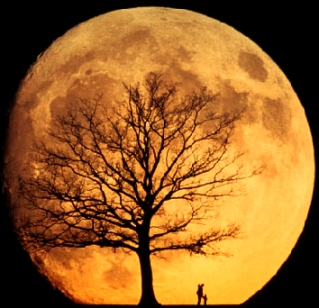
"Wow, the Moon's even bigger than that tree!"
You’ve probably all seen it before, a huge Full Moon sitting on the horizon. Time and again I have had people ask me why the Moon is so much bigger some times than others, and the answer is: it isn’t, really.
The Moon orbits the Earth in an elliptical orbit, meaning that it is not always the same distance from the Earth. The closest the Moon ever gets to Earth (called apogee) is 364,000km, and the furthest is ever gets (perigee) is around 406,000km (these figures vary, and in fact this Full Moon on 19 March 2011 will see a slightly closer approach of 357,000km).
So the percentage difference in distance between the average perigee and the average apogee is ~10%. That is, if the Full Moon occurs at perigee it can be up to 10% closer (and therefore larger) than if it occurred at apogee.
This is quite a significant difference, and so it is worth pointing out that the Moon does appear to be different sizes at different times throughout the year.
But that’s NOT what causes the Moon to look huge on the horizon. Such a measly 10% difference in size cannot account for the fact that people describe the Moon as “huge” when they see it low on the horizon.
What’s really causing the Moon to look huge on such occasions is the circuitry in your brain. It’s an optical illusion, so well known that it has its own name: the Moon Illusion.
If you measure the angular size of the Full Moon in the sky it varies between 36 arc minutes (0.6 degrees) at perigee, and 30 arc minutes (0.5 degrees) at apogee, but this difference will occur within a number of lunar orbits (months), not over the course of the night as the Moon rises. In fact if you measure the angular size of the Full Moon just after it rises, when it’s near the horizon, and then again hours later once it’s high in the sky, these two numbers are identical: it doesn’t change size at all.
So why does your brain think it has? There’s no clear consensus on this, but the two most reasonable explanations are as follows:
1. When the Moon is low on the horizon there are lots of objects (hills, houses, trees etc) against which you can compare its size. When it’s high in the sky it’s there in isolation. This might create something akin to the Ebbinghaus Illusion, where identically sized objects appear to be different sizes when placed in different surroundings.

Ebbinghaus Illusion – the two orange circles are exactly the same size
2. When seen against nearer foreground objects which we know to be far away from us, our brain thinks something like this: “wow, that Moon is even further than those trees, and they’re really far away. And despite how far away it is, it still looks pretty big. That must mean the Moon is huge!”.
These two factors combine to fool our brains into “seeing” a larger Moon when it’s near the horizon compared with when its overhead, even when our eyes – and our instruments – see it as exactly the same size.

by Steve Owens | Mar 10, 2011
Originally posted on Dark Sky Diary by Steve Owens @darkskyman
There seems to be a growing excitement about the “Supermoon” that is due to occur on 19 March 2011, when the Moon will be at its closest to Earth in this orbit, and closer than it has been at any time since 1992.

Moon – not Super
The Moon orbits the Earth in an elliptical orbit, i.e. it is not perfectly circular, and so in each orbit there is a closest approach, called “perigee” and a furthest approach, called “apogee”.
At this month’s perigee the Moon will be 356,577km away from Earth, and will indeed be at its closest in almost 20 years. But how close is it compared with other perigees?
Let’s start by comparing it to the Moon’s average distance from the Earth, which is ~385,000km. This perigee will be ~8% closer to the Earth than average. OK, that’s a bit closer, but not significantly so.
What about comparing it to the Moon’s average perigee distance, which is ~364,000km. So this “Supermoon” will be ~2% closer to the Earth than it is most months at perigee. Wow!
So what will this mean to you? Nothing at all. The Moon will be a few percent bigger in the sky, but your eye won’t really be able to tell the difference. It will also be a few percent brighter, but your eye will compensate for this too, so altogether this “Supermoon” will look exactly the same as it always does when it’s full.
As to all of those soothsayers claiming that there will be earthquakes and tidal waves. There very well might be, but they’ll be nothing at all to do with the Moon.
UPDATE: I predict that lots of people will report having seen a huge Moon on or around 19 March